
If you own rural property, farm, or have forestry on your land, five new government regulations coming into force this year will directly affect what you can do on your property — and what your neighbours, lines companies, and forestry operators can do near you. In this article, we break down each change, explain what it means in practice, and set out the steps you should take now.
Key Takeaways
1. Stock exclusion rules have been relaxed. Non-intensively grazed beef cattle and deer no longer need to be fenced out of certain wetlands (in force 7 May 2026).
2. New nationally consistent rules for power lines are coming. If you have overhead distribution lines on your property, new rules will govern earthworks, buildings, and subdivision near them.
3. Forestry slash management is changing. A new risk-based approach replaces blanket slash removal requirements, and councils will have less power to impose their own stricter rules.
4. Cell tower rules are being updated including expanded setback distances in rural areas and new provisions for solar and battery storage at rural sites.
5. Marine aquaculture consenting is being streamlined to make it easier for marine farm operators to reconsent, add species, and run trials.
Who Does This Affect?
These changes are relevant to you if you own or manage rural land with overhead power lines, run a beef, deer, dairy, or mixed livestock operation near wetlands or waterways, own or neighbour commercial forestry land, hold a marine farming consent or operate in coastal areas, or are planning earthworks, new buildings, or subdivision on rural property.
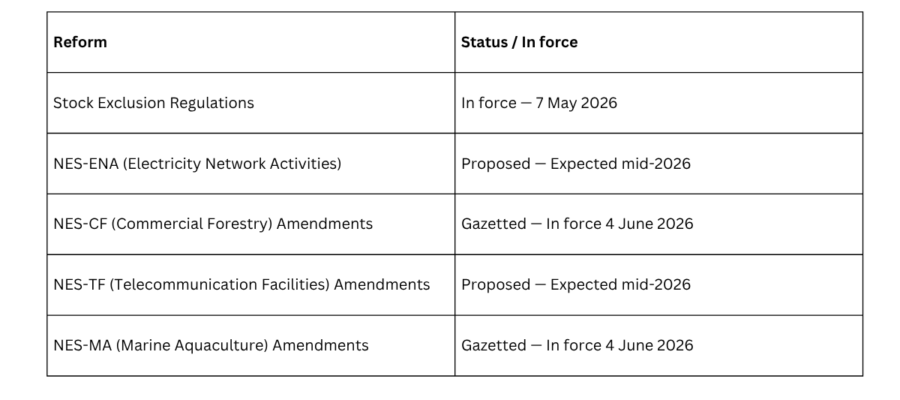
What Is Changing?
The Government is overhauling New Zealand’s resource management system. As part of this reform, new National Environmental Standards (NES) and a new Stock Exclusion Regulation are coming into effect. The Government has signalled that these changes are intended to carry into the wider Resource Management Act 1991 (RMA) reform.
The full replacement of the RMA is still underway. Two new Bills — the Planning Bill and the Natural Environment Bill — are currently at the select committee stage in Parliament, with a report from the Environment Committee expected in mid-2026.
1. Stock Exclusion: Relief for some Beef and Deer Farmers
• If you run a low-intensity beef or deer operation — meaning your stock are not break-feeding, grazing annual forage crops, or on irrigated pasture — you are no longer required to fence stock out of the wetlands that were previously covered by the exclusion requirements.
• Dairy cattle, dairy support cattle, intensively grazed beef cattle and deer, and pigs remain covered. If you run any of these stock types, the fencing obligations continue to apply in full.
• The exemption was driven by concerns — particularly from South Island high country farmers — that the cost of fencing remote wetlands on extensive properties was disproportionate to the environmental benefit.
The freshwater farm plan system is also still under review, with implementation decisions expected later in 2026. The regulatory landscape for stock and waterways is still shifting.
2. Power Lines: New Nationally Consistent Rules for Rural Properties
Most rural properties have overhead electricity distribution lines running across them. Until now, the rules about what you could do near those lines varied from council to council.
The National Environmental Standards for Electricity Network Activities (NES-ENA) will overhaul and change what activities you can do around electricity transmission lines.
What does this mean for you:
• Earthworks near lines: If you’re digging, trenching, or drilling on a site with overhead distribution lines, you’ll need to comply with the safe electrical distance requirements in NZECP 34:2001. Compliant earthworks are permitted without a consent. Non-compliant earthworks — for example, excavation too close to a pole — will require either a dispensation from your electricity distribution business (EDB) or a discretionary activity resource consent.
• New buildings and structures: Planning a new shed, woolshed, or farm building near overhead lines? The same NZECP 34:2001 safe distance rules apply. If your building can’t meet the required setbacks, you may need a consent.
• Subdivision: If you’re subdividing rural land that has overhead distribution lines on it, every new allotment must be able to accommodate a building platform that complies with NZECP 34:2001. This is now a controlled activity — meaning consent must be granted, but conditions can be imposed.
• Routine network maintenance: Your EDB will have broader permitted activity rights to carry out maintenance, vegetation trimming, and minor upgrades on lines crossing your property — often without needing a resource consent. In sensitive environments (natural areas, historic heritage sites), additional standards apply.
3. Forestry: Slash Management and Council Powers
The amendments to the National Environmental Standards for Commercial Forestry (NES-CF) were gazetted on 7 May 2026 and come into force on 4 June 2026. The reforms address three contentious issues: when councils can impose stricter rules than the national standards, how slash is managed after harvesting, and what information foresters need to provide before planting.
What this means for you:
• Slash mobilisation risk assessments (SMRAs): If you’re harvesting on orange or red zone erosion-susceptible land, you’ll need to complete an SMRA as part of your harvest management plan. This replaces the previous blanket requirement to remove slash above a certain size — a standard that industry said was near-impossible to meet. The SMRA approach focuses effort on the highest-risk sites.
• Council stringency is narrowing Councils will have less room to impose rules stricter than the NES-CF. The amended regulation 6(1)(a) limits more stringent rules to situations involving severe erosion with significant downstream effects that can’t be managed through the existing NES-CF. And regulation 6(4A) — which gave councils broad discretion over afforestation — is being repealed entirely.
• Afforestation controls are standardising: The repeal of regulation 6(4A) means councils will have less discretion to impose local afforestation rules. If you’re planning new planting, the national rules will apply more consistently.
A word of caution: Regional plan rules on stock exclusion may still apply independently of the national regulations. Check with your regional council whether any local rules impose additional requirements.
4. Cell Towers: Updated Rules for Rural Telecommunications
The proposed amendments to the NES for Telecommunication Facilities (NES-TF) are expected to come into force mid-2026. While largely focused on urban areas, several changes are relevant to rural landowners.
What this means for you:
• The 50-metre rural setback is expanding: Currently, new telecommunication poles outside the road reserve in rural zones must be at least 50 metres from any building used for residential or educational purposes. The reforms extend this setback to also apply to poles in the road reserve — meaning a new cell pole on the roadside near your house will also need to meet the 50-metre distance.
• Existing poles are grandfathered: If there’s already a pole within the 50-metre setback, it can be relocated, increased in size, or have its headframe replaced without triggering a new consent. This provides flexibility for operators upgrading existing infrastructure.
• You can agree to host a facility: If a telecommunications company wants to put a pole on your land within the setback, the rules allow for this by agreement. Some rural landowners may see this as an opportunity — hosting a cell site can come with lease payments and improved connectivity for your area.
• Solar and battery storage at rural sites: New rules permit small-scale solar panels, wind turbines, and battery storage to power rural telecommunication facilities. This supports off-grid connectivity in remote areas and may mean new equipment appearing near existing rural cell sites.
5. Marine Aquaculture: Streamlined Consenting for Coastal Operators
The amendments to the NES for Marine Aquaculture (NES-MA) were gazetted on 7 May 2026 and come into force on 4 June 2026. The reforms are designed to reduce barriers to reconsenting and make it easier for marine farm operators to adapt their operations. What this means for you:
• Streamlined pathways to add new species, update structures, and change monitoring conditions without full reconsenting.
• A new controlled activity pathway for small-scale research and trials.
• All marine farms — including those consented after 2020 — can now use the NES-MA reconsenting processes.
The key concern for coastal communities is that streamlined consenting may reduce opportunities for public and iwi input. However, notification requirements for affected customary title and protected customary rights groups are maintained.
What Should You Do Now?
1. Check your property: Identify whether you have overhead power lines, wetlands, forestry, or coastal operations that are affected by these changes.
2. Review your stock exclusion obligations: If you run beef cattle or deer, confirm whether your operation qualifies as non-intensively grazed under the new exemption.
3. Talk to your lines company: If you are planning earthworks, new buildings, or subdivision near overhead distribution lines, contact your electricity distribution business to confirm the safe distance requirements.
4. Update your harvest management plan: If you have commercial forestry on erosion-susceptible land, ensure your plan includes a slash mobilisation risk assessment before 4 June 2026.
5. Check your marine farm consent: If you hold a marine farming consent, review whether the streamlined reconsenting pathways could benefit your operation.
6. Get legal advice early: The interaction between these new national standards, your regional and district plan rules, and any existing resource consents can be complex. Getting advice before you commit to a project can save significant time and cost.
When Should You Seek Legal Advice?
We recommend seeking legal advice early if:
1. you are planning earthworks, buildings, or subdivision near overhead power lines and are unsure about safe distance requirements;
2. you have potential wetlands on your property or are uncertain whether your operation qualifies for the new beef cattle and deer exemption;
3. you own forestry land on erosion-susceptible terrain and need to understand the new slash management requirements;
4. you are reconsenting a marine farm and want to take advantage of the streamlined pathways;
5. you are unsure how these national standards interact with your regional or district plan rules; or
6. you are involved in a subdivision or development near infrastructure (power lines, cell towers) and need to navigate the consent requirements.
We are happy to help you navigate these changes and ensure your property, farm, or business is on solid legal footing